
More Than Test Scores: Building an Educational Ecosystem to Support Every Child’s Path to Success
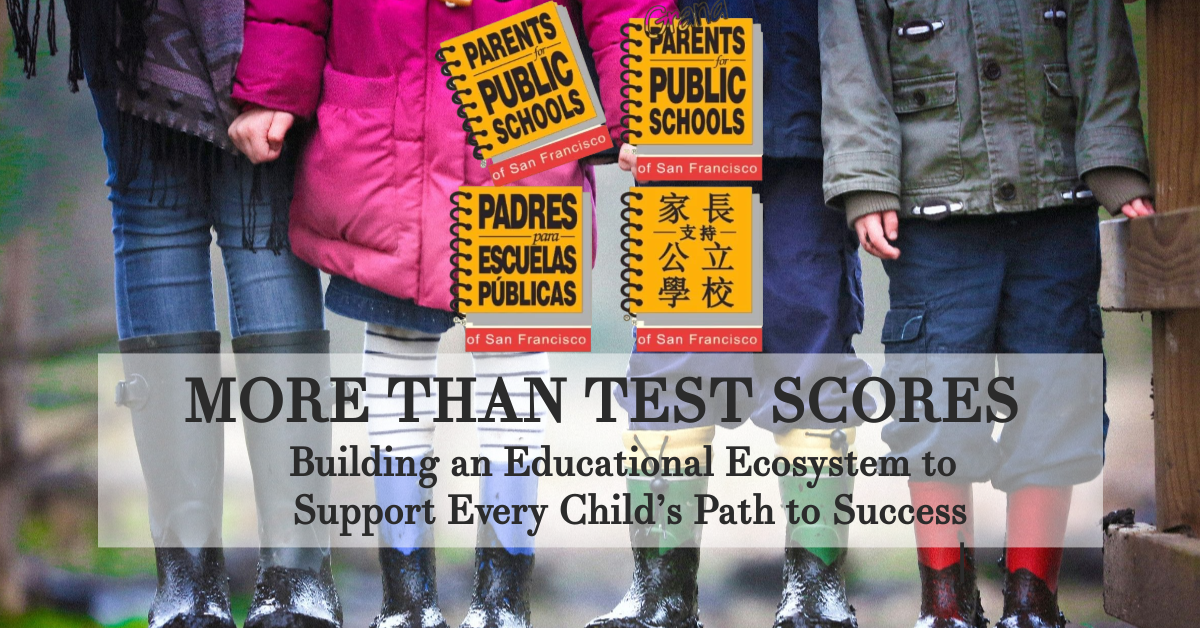
Children standing side by side wearing boots and jackets, holding multilingual “Parents for Public Schools of San Francisco” notebooks, with text reading “More Than Just Test Scores: Building an Educational Ecosystem to Support Every Child’s Path to Success.”
A thriving democracy depends on participation. And for every person to participate meaningfully, they must first develop a voice.
For children, that voice is not shaped by test scores alone. It is cultivated through the culmination of their families’ lived experiences, their environment, their culture, and whether the systems around them recognize and respond to their realities.
If we want every child to have a genuine pathway to success, our education system must move beyond narrow academic metrics and toward a holistic educational ecosystem—one designed by people, for people, grounded in lived experience.
From Schools to Ecosystems
For decades, education policy has emphasized accountability frameworks centered on standardized testing. While academic benchmarks matter, they tell only a fraction of the story. Learning does not happen in isolation from housing stability, food security, health, safety, or a child’s ability to emotionally regulate in the classroom.
An educational ecosystem recognizes that:
Children learn best when they feel safe, seen, and supported
Families are partners, not obstacles, in education
Schools function best when they are embedded within coordinated systems of care
When these conditions are absent, children do not simply “fall behind academically.” Their bodies and brains shift into survival mode. Neuroscience tells us that chronic stress impairs memory, attention, and executive functioning—skills essential for learning.
This reality demands a child-centered development approach.
Why Child-Centered Development Must Be a Policy Priority
Child-centered development places children’s health, well-being, and environmental conditions at the center of education and budget policy. It recognizes that academic outcomes are deeply shaped by the environments in which children grow.
Persistent disparities in educational achievement closely track zip code, income and neighborhood conditions. Children in low-income and under-resourced communities consistently demonstrate lower academic performance—not due to lack of ability or effort, but because of systemic barriers to healthy development.
The Evidence Is Clear
Neighborhood conditions matter: Children growing up in concentrated poverty experience higher levels of chronic stress, which interferes with brain architecture and learning capacity (Harvard Center on the Developing Child).
Food insecurity impacts learning: Food-insecure children are more likely to experience developmental delays, behavioral challenges, and lower academic achievement (USDA; CDC).
Transportation deserts limit access: Families without reliable transportation face barriers to early education, healthcare, and consistent school attendance (Urban Institute).
Housing quality affects brain development: Exposure to lead, mold, and other environmental toxins is associated with lower IQ, attention disorders, and long-term learning challenges (CDC; EPA).
Health drives attendance: Children with untreated asthma, anxiety, or unmet health needs miss more school days, contributing directly to learning loss (CDC).
The CDC estimates that approximately 24 million children in the U.S. live in housing with lead-based paint hazards, and even low levels of lead exposure are linked to irreversible cognitive impairment. Meanwhile, the Harvard Center on the Developing Child has documented that prolonged exposure to toxic stress—common in under-resourced environments—alters brain development and weakens the foundation for learning.
When these conditions are concentrated in specific neighborhoods, schools alone cannot compensate.
Policy Implication
If we want to close achievement gaps, we must first close opportunity gaps. That requires aligning education policy with housing, transportation, public health, and environmental policy—through a child-centered lens.
Education does not begin at kindergarten, nor does it end at the classroom door. It begins with whether a child is:
Safely housed
Well-nourished
Able to get to school
Physically and emotionally healthy
Child-centered development is not an add-on. It is foundational.
The Role of Community Schools
Community Schools operationalize child-centered development at the neighborhood level. They integrate education with health, mental health, family engagement, and social services—meeting children where they are.
Evidence from California’s Community Schools Partnership Program shows that participating schools achieved:
~30% greater reductions in chronic absenteeism
Lower suspension rates, particularly for students of color
Academic gains equivalent to 36–43 additional days of learning in math and English language arts
(Source: Learning Policy Institute)
These outcomes were achieved not through higher stakes or exclusionary discipline, but through collaboration, prevention, and coordinated supports.
Why Social Workers (and Paraprofessionals) Are Essential to Learning
Social workers are a linchpin of effective educational ecosystems.
When children experience housing instability, food insecurity, or trauma, their nervous systems remain in survival mode. Embedded school social workers help stabilize families by:
Connecting them to housing, food, healthcare, and mental health supports
Coordinating care across systems
Empowering caregivers to support learning at home
This allows teachers to teach—maximizing instructional time and reducing burnout. Systems of care are not distractions from learning; they are what make learning possible.
Social Emotional Learning Is as Essential as Literacy and Math
Social emotional learning (SEL) strengthens emotional regulation, classroom behavior, and academic engagement. Longitudinal research shows that every $1 invested in evidence-based SEL yields approximately $11 in long-term public benefit, including higher earnings and reduced reliance on public systems.
(Source: Robert Wood Johnson Foundation; Columbia University)
Yet SEL access declines as students age, particularly in under-resourced schools—contributing to classroom disruptions, loss of instructional time, and punitive discipline practices.
Sustained SEL and trauma-informed professional development for all school staff are essential to:
Maintain safe learning environments
Support complex dialogue across difference
Prepare students for civic participation
Budget Cuts in Childhood Undermine Proven Systems of Care
Despite strong evidence, social workers, wellness centers, and community partnerships are often first on the chopping block during budget shortfalls.
These cuts do not eliminate costs—they shift them downstream to emergency services, justice systems, and homelessness supports. Long-term studies consistently show that early, preventive investments save public dollars over time.
A Call to Action: Align Budgets With Evidence and Values
Our state budget is a moral document. It reflects what—and who—we value.
The evidence is unequivocal. Child-centered development, community schools, social workers, early education, and SEL improve outcomes and reduce long-term public costs. These are not experimental ideas. They are proven strategies.
Yet too often, education budgeting treats opportunity as a zero-sum game—sorting children into winners and losers instead of building systems that allow everyone to succeed.
Our education system should not ration opportunity. It should cultivate potential.
We urge policymakers to:
Align state budgets with evidence-based, child-centered practices
Invest across systems—education, housing, transportation, health—with children at the center
Protect community schools and systems of care from short-term cuts
Reject false tradeoffs between academic rigor and student well-being
Education is not about competition. It is about collaboration.
When children are healthy, regulated, and supported, they become adults capable of thoughtful dialogue, shared problem-solving, and civic participation.
As humans, this is our greatest potential.
It is time to build for children—and to let our policies and budgets reflect that commitment.
To design public systems that prioritize children’s health, happiness, and development from the start. To align education, housing, transportation, and public health policy around a shared goal: ensuring every child has the conditions they need to learn, grow, and succeed.
When we center children in our development decisions, we do not just improve academic outcomes. We build healthier communities, stronger economies, and a more resilient democracy.
References
Child-Centered Development, Brain Science & Toxic Stress
Harvard University, Center on the Developing Child. The Science of Early Childhood Development (InBrief).
https://developingchild.harvard.edu/resources/inbrief-science-of-ecd/Harvard University, Center on the Developing Child. Toxic Stress Derails Healthy Development.
https://developingchild.harvard.edu/science/key-concepts/toxic-stress/
Neighborhood Conditions, Poverty & Educational Outcomes
Chetty, R., Hendren, N., & Katz, L. (2016). The Effects of Exposure to Better Neighborhoods on Children. American Economic Review.
https://opportunityinsights.org/paper/new-neighborhoods/Urban Institute. Transportation Barriers and Access to Opportunity.
https://www.urban.org/research/publication/transportation-barriers-and-access-opportunity
Food Insecurity & Child Development
U.S. Department of Agriculture (USDA). Household Food Security in the United States.
https://www.ers.usda.gov/topics/food-nutrition-assistance/food-security-in-the-u-s/Centers for Disease Control and Prevention (CDC). Food Insecurity and Children’s Health.
https://www.cdc.gov/healthyschools/foodsecurity/index.htm
Housing Quality, Environmental Toxins & Learning
Centers for Disease Control and Prevention (CDC). Childhood Lead Poisoning Prevention.
https://www.cdc.gov/nceh/lead/prevention/default.htmEnvironmental Protection Agency (EPA). Protect Your Family From Lead in Your Home.
https://www.epa.gov/lead/protect-your-family-lead-your-homeNational Center for Healthy Housing. Housing and Health Inequities.
https://nchh.org/information-and-evidence/learn-about-healthy-housing/
Health, Attendance & Learning
Centers for Disease Control and Prevention (CDC). Health and Academic Achievement.
https://www.cdc.gov/healthyschools/health_and_academics/index.htm
Community Schools
Learning Policy Institute. California Community Schools: Evidence on Implementation and Impact.
https://learningpolicyinstitute.org/product/ca-community-schools-impact-student-outcomes-reportCoalition for Community Schools. Community Schools: An Evidence-Based Strategy for Equitable Education.
https://www.communityschools.org/resources/evidence/
Social Workers & Systems of Care
National Association of Social Workers (NASW). School Social Work Services.
https://www.socialworkers.org/Advocacy/Policy-Issues/School-Social-Work
Social Emotional Learning (SEL)
Learning Policy Institute. Evidence for Social and Emotional Learning in Schools.
https://learningpolicyinstitute.org/product/evidence-social-emotional-learning-schools-briefBelfield, C., et al. (2015). The Economic Value of Social and Emotional Learning. Columbia University.
https://casel.org/wp-content/uploads/2016/01/SEL-Revised.pdfRobert Wood Johnson Foundation. Improving Social-Emotional Skills in Childhood Enhances Long-Term Well-Being.
https://www.rwjf.org/en/insights/our-research/2017/07/improving-social-emotional-skills-in-childhood-enhances-long-term-well-being.html
Early Childhood Investment & Long-Term Public Savings
Heckman, J. J. (2011). The Economics of Inequality: The Value of Early Childhood Education. American Educator.
https://www.aft.org/sites/default/files/periodicals/Heckman.pdfScienceDaily. High-Quality Early Childhood Education Has Lasting Benefits.
https://www.sciencedaily.com/releases/2011/02/110204091258.htm