
2026 Labor Agreement and SFUSD budget surpluses
Graphic featuring a quote by Noah Sloss, Regional Director of SF, under the "Parents for Public Schools" logo. The text details how a school district is allegedly using $111.5 million from a surplus moved into Fund 17 to fund salary and benefit increases for the 2026 labor agreement.
Summary
Parents’ concerns that the district is hoarding surplus balances instead of “spending today’s dollars on today’s students” are not resolved. The multi-year budget presented in June 2026 shows an unspent surplus balance of $180 million at the end of the 2028-29 budget year.
Instead of spending some of the projected $327 million surplus in the 2025-26 budget year the district cut $85 million from expenditures. In their presentation the district says $15 million of this was cut from Central Office functions, but that leaves $70 million of programs and salaries that were eliminated.
The district says the surplus can’t be spent on ongoing expenses, but it seems to be doing so. One way is taking $111.5 million from the surplus, moving it to Fund 17 then using Fund 17 to pay for –– some of –– the salary and benefit increases in the 2026 labor agreement. The rest of the labor agreement increases look to be paid out as part of the yearly expenditures. Also by overspending on the Restricted budget in the later years of the multi year projection and using the Restricted surplus to cover. It seems like the district can, in fact, spend the surplus if forced to by a strike.
Note: Charts below are from this spreadsheet with analysis based on SFUSD’s presentations and documents. Also please see note at the end for a definition of the difference between Reserves and Ending Fund Balances.
SFUSD claims it cannot use its budget surplus for ongoing expenses, but its actual financial actions contradict this claim. How so?
Contradictory Spending: Despite saying surplus funds cannot cover ongoing costs, the district appears to be doing so by moving $111.5 million into Fund 17 to help pay for salary and benefit increases from the 2026 labor agreement.
Unnecessary Cuts: Rather than utilizing its projected $327 million surplus, the district cut $85 million from expenditures—$70 million of which directly impacted school programs and salaries rather than central office functions.
Leverage Impact: The district's actions demonstrate that it is able to tap into its surplus when pressured, such as under the threat of a strike.
Unresolved Parent Concerns: The district continues to hold onto large reserve balances (projected at $180 million unspent by 2028–29) instead of directing those funds toward current students.
Budget Surpluses (AKA Ending Fund Balance)
Before the teachers’ strike in early 2026 there was a lot of talk of budget surpluses. This is money not spent during the July-to-June budget year which is carried over to the next year. The teachers’ union and their supporters, including a new organization called Propel, showed that the district was showing a $429 million surplus at the start of the 2025-26 budget year and $327 million surplus at the end of the same budget year. The district insisted that these funds could not be spent on the raises and other benefits the union was asking for.
Over the Winter of 2025 the district took $111.5 million from the budget surplus and assigned it to a new line item called Fund 17, a “special reserve”. The remaining 2025-26 projected surplus was now around $215 million.
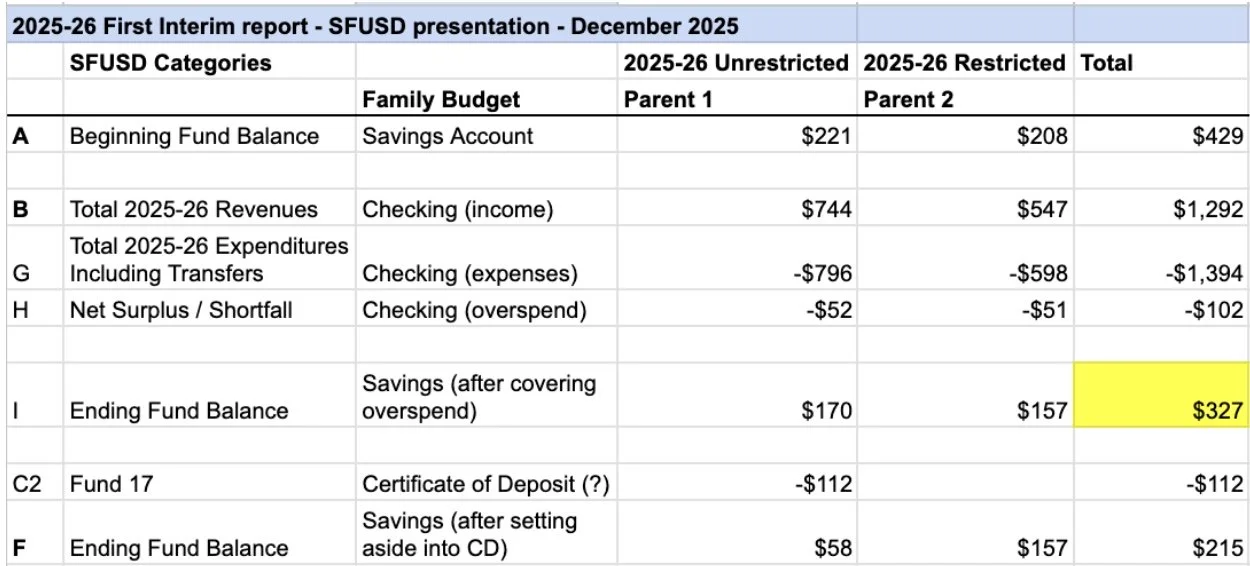
Table comparing SFUSD 2025–26 budget categories (Unrestricted, Restricted, and Total) using a "Family Budget" analogy. It shows a Beginning Fund Balance of $429M ($221M Unrestricted, $208M Restricted), Total Revenues of $1,292M, Total Expenditures of -$1,394M, and a Net Shortfall of -$102M. This results in an Ending Fund Balance of $327M ($170M Unrestricted, $157M Restricted). After moving -$112M into Fund 17, the final Ending Fund Balance is $215M ($58M Unrestricted, $157M Restricted).
2026 Labor Agreement
As the strike ended, news reports stated the agreement between the union and district management amounted to $183 million. This was to be spent over the next two years, with retroactive effect to the start of the 2025-26 school year.
Where would the additional $183 million spend come from? Would the district use the budget surplus or the Fund 17 special reserve? If not, would the district make cuts to the overall yearly expenditures to accommodate the increases in the agreement?
In the first news articles Superintendent Su said it would come from Fund 17. But Fund 17 ($111.5 million) is $72.5 million short of the full agreement amount ($183 million).
In the year-end Standardized Account Code Structure (SACS) budget report the district prepared for the State Board of Education there is this statement, in the sections labeled “Cost Analysis of District's Labor Agreements”:
Identify the source of funding that will be used to support multiyear salary commitments:
For UESF Certificated salary increases, an estimated 77% of costs will be charged to Unrestricted Resources and 23% to Restricted Resources. Local Restricted Parcel Taxes will cover 100% of the costs associated in increasing health care coverage if needed. Declining enrollment and shifts of positions from unrestricted to restricted funds as well as Central Office reductions will reduce costs in the future fiscal years. Board Local Reserve Fund 17 will be drawn down to balance the budget if needed.
The SACS doesn’t show the retroactive 2025-26 agreement costs, but instead shows them in years 2026-27, 2027-28 (the two years of the agreement) and projects them into 2028-28, assuming they will continue.
Expenditures
Unrestricted and Restricted are the two parts of SFUSD’s $1.3 billion yearly General Fund budget. The statement in the SACS report makes it sound like the General Fund will be used first to pay for the labor agreement.
Note: Local Restricted Parcel Taxes show in the SACS report as included in Restricted revenues.
So we would expect to see increases in expenditures in each year compared to the previous. However, between the December 2025 1st interim budget presentation and the June 2026 estimated actuals, the district didn’t increase expenditures. It cut expenditures by $85 million for the 2025-26 budget year.
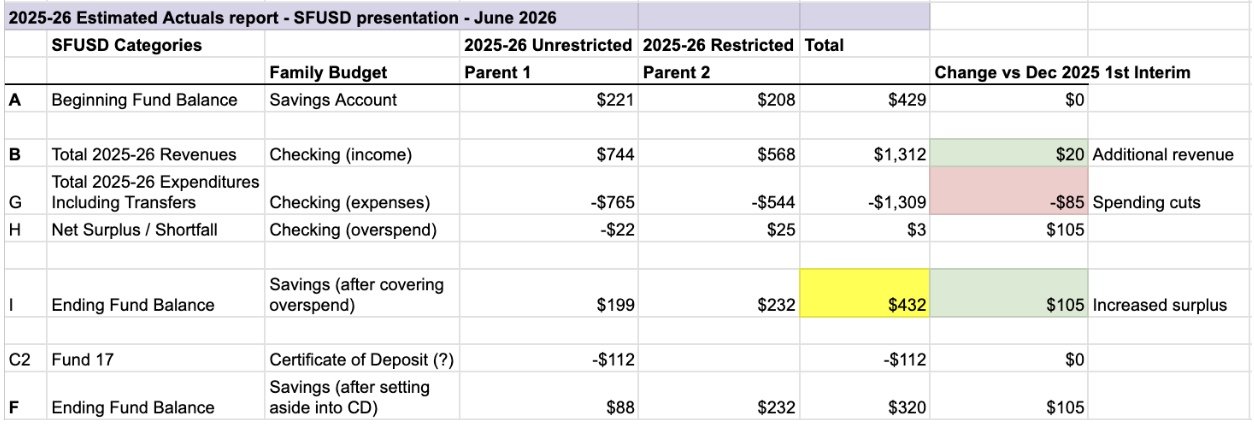
Table displaying the SFUSD 2025–26 Estimated Actuals report (June 2026 presentation) with a "Family Budget" analogy. It shows a Beginning Fund Balance of $429M ($221M Unrestricted, $208M Restricted), Total Revenues of $1,312M ($20M increase from Dec 2025), Total Expenditures of -$1,309M ($85M in spending cuts), and a Net Surplus of $3M. The Ending Fund Balance is $432M ($199M Unrestricted, $232M Restricted). After allocating -$112M to Fund 17, the final Ending Fund Balance is $320M ($88M Unrestricted, $232M Restricted), reflecting a total increase of $105M from the December 2025 interim report.
This is how the district “balanced the budget” and moved towards closing the ~$100 million yearly General Fund “fiscal cliff” that mainstream legacy news referred to constantly. All while the media ignored the fact the district had at least $327 million worth of budget surplus from previous years. These $85 million in cuts plus $20 million in additional revenue actually increased the budget surplus to $432 million (including Fund 17).
Agreement costs in excess of expenditure increases — or cuts
Using the SACS yearly agreement costs for 2026-27 ($74 million) and for 2027-28 ($92 million), subtracting them from the total agreement cost ($183 million) leaves $17 million for retroactive expenditures in the 2025-26 budget year.
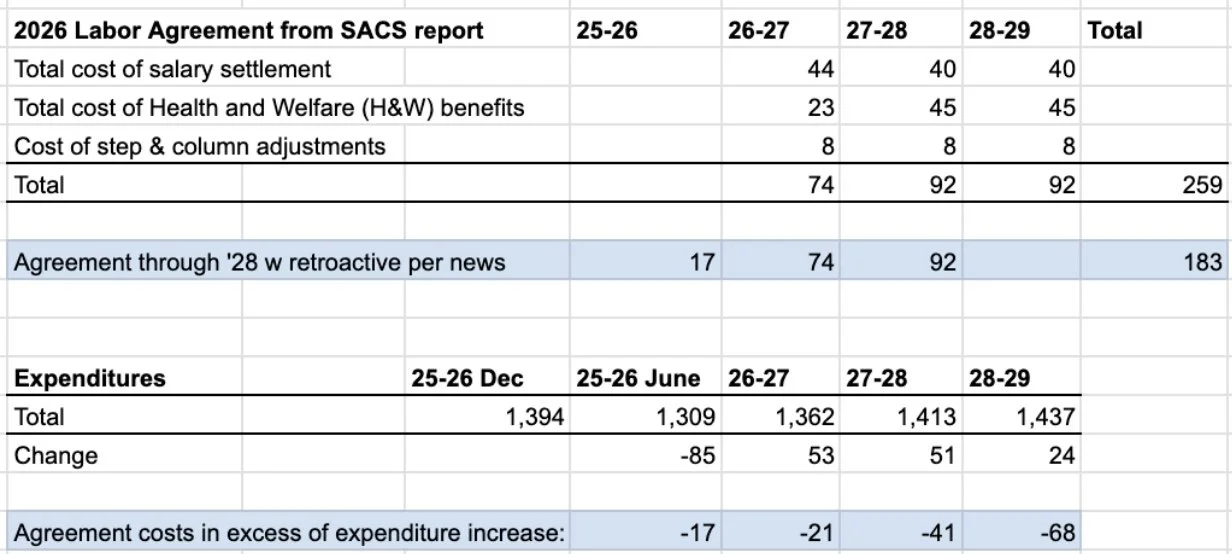
Table titled "2026 Labor Agreement and SFUSD budget" comparing SACS report costs ($259 million total through 2028-29) against expenditure changes, showing that labor agreement costs exceed expenditure increases by $17M in 2025-26, $21M in 2026-27, $41M in 2027-28, and $68M in 2028-29.
For 2025-26 — assuming the district didn’t make $17 million of cuts in addition to the $85 million — the retroactive agreement amount must have come from somewhere else.
For 2026-27 there is an increase in expenditures of $53 million. But this is $21 million short of the $74 million increase in the agreement - assuming all of the $53 million is used for the increase.
Similarly for 2027-28 there is an increase in expenditures of $51 million. But this is $41 million short of the $92 million increase in the agreement - assuming all of the $5 million is used for the increase.
Where is the excess paid from?
Increased Revenue? No.
The district’s June 2026 budget presentation shows some relatively small Revenue increases for 2025-26 and 2026-27 ($21 million and $53 million), a $16 million decrease in 2027-28 and a smaller increase ($9 million) in 2028-29.
But these result in only a tiny increase in the yearly surplus (Revenue minus Expenditures) of $3 million for 2025-26 and 2026-27 and larger yearly deficits of $64 and $79 million in 2027-28 and 2028-29. So the revenue increases barely cover the increased expenditures or fall short.
Expenditures? Probably.
The linked Google Sheet assumes that every dollar of year-over-year increases in spending is used towards covering the increases from the labor agreement.
Ending Fund Balance? Somewhat.
The changes in Ending Fund Balance match the Revenue minus Expenditures (AKA yearly surplus/deficit) exactly. It’s not used to pay for the excess needed to cover the labor agreement. The district is using some of it to cover deficits in 2027-28 and 2028-29, but still winds up at the end up at the end of the forecast period with a $180 million unspent Ending Fund Balance.
Fund 17? Probably.
The Fund 17 balance is not shown in the district’s multi-year forecast presentations, so we can’t know for sure. If it were used to pay for the agreement, in excess of yearly expenditure changes, the $115.5 million in Fund 17 would last through the end of 2027-28 and show a deficit in 2028-29.
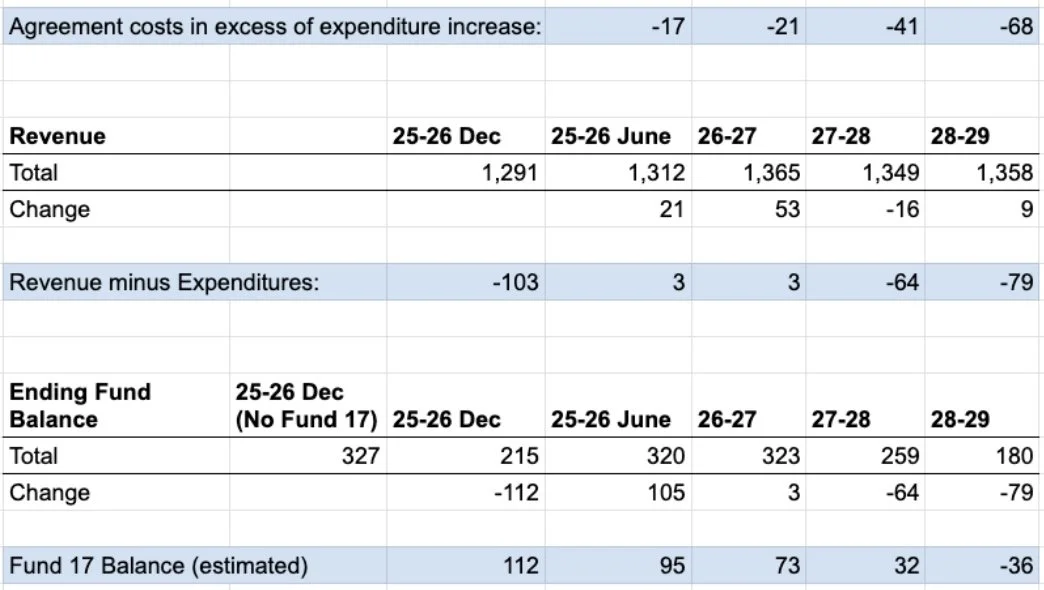
Table titled "Labor Agreement and SFUSD budget" displaying multi-year projections (2025-26 through 2028-29) for Revenue, Expenditures, Ending Fund Balance, and Fund 17, showing a projected ending fund balance of $180M and an estimated Fund 17 balance of -$36M by 2028-29.
Definition of Reserves vs Ending Fund Balance
In Facts on SFUSD’s budget posted by the district just before the strike ended with an agreement, the district argues that the public and organizations like Propel don’t understand the difference between Ending Fund Balance and Reserves. The implication is that Ending Fund Balance is not available to be spent, because it’s not a reserve.
The SACS budget (below) shows only the Unrestricted fund balance PLUS Fund 17 – which was drawn from the Unrestricted fund balance – in the Available Reserves section. The large Restricted fund balance is not included in Available Reserves, but the Fund Balance section shows the Restricted balance declining year-over-year. The fund balance not included in reserves is being spent. So it’s a distinction without a significant difference.
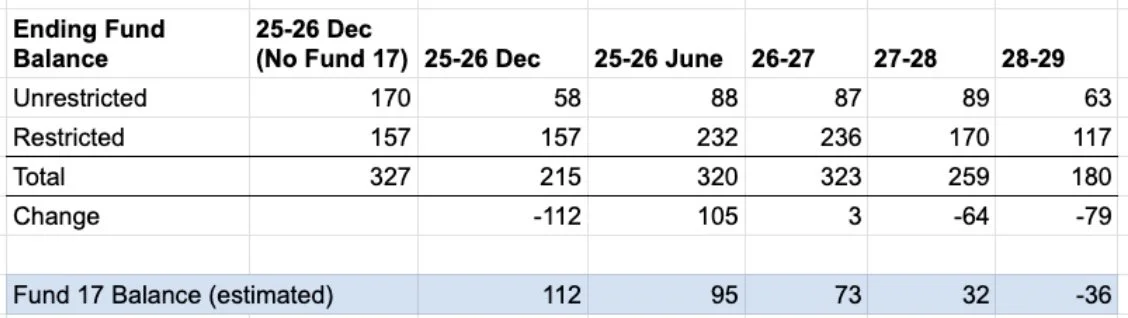
Financial table breaking down SFUSD's projected Ending Fund Balance and Fund 17 Balance across fiscal years 2025–26 through 2028–29, showing total fund balances moving from $327M down to $180M and estimated Fund 17 balances dropping from $112M to -$36M.
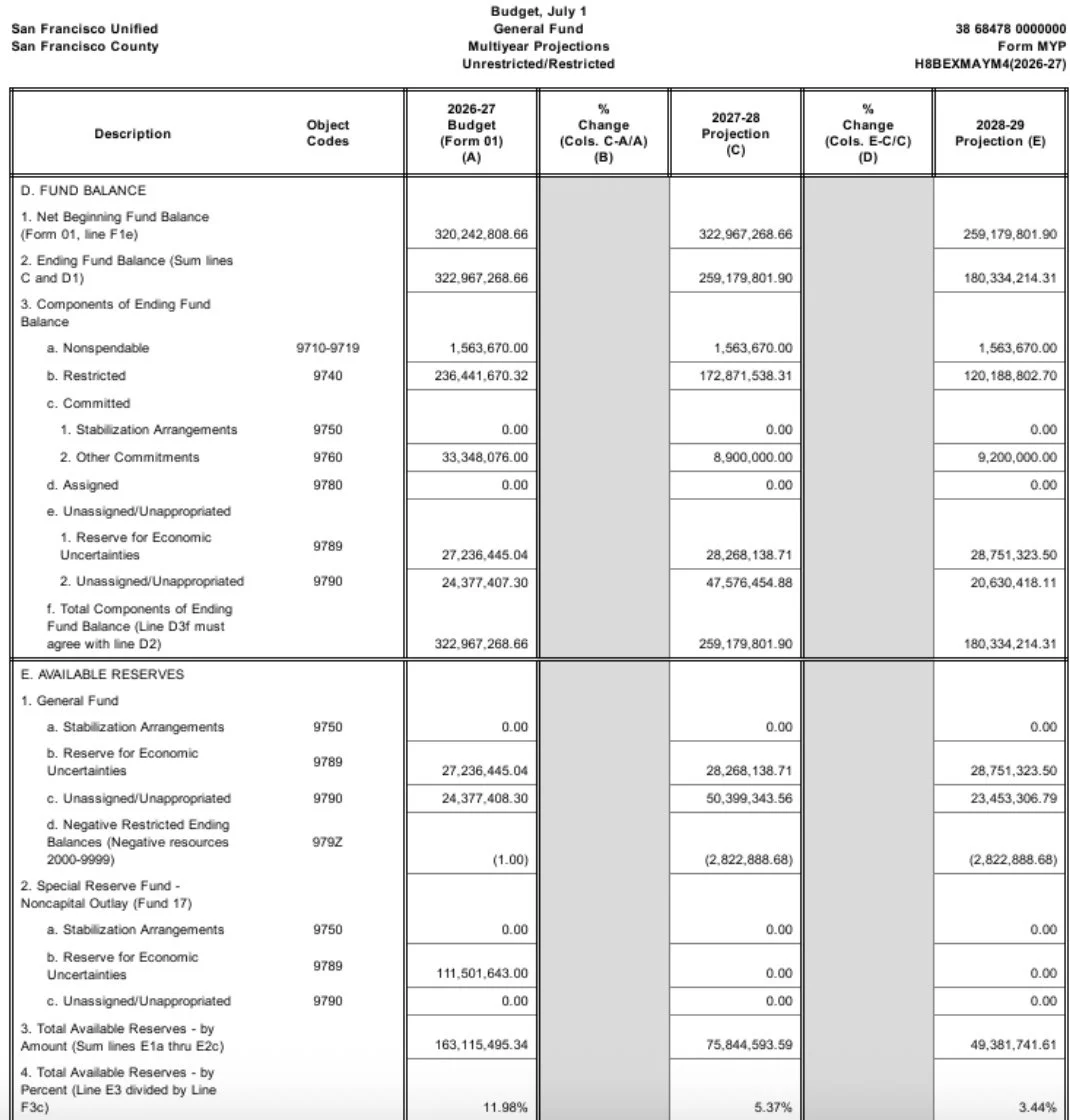
Table showing San Francisco Unified School District's General Fund Multiyear Projections (Form MYP) for fiscal years 2026–27 through 2028–29, detailing Fund Balance, Restricted vs. Unrestricted components, and Total Available Reserves declining from $163.1M (11.98%) in 26–27 down to $49.4M (3.44%) in 28–29.